The tower that invented the type
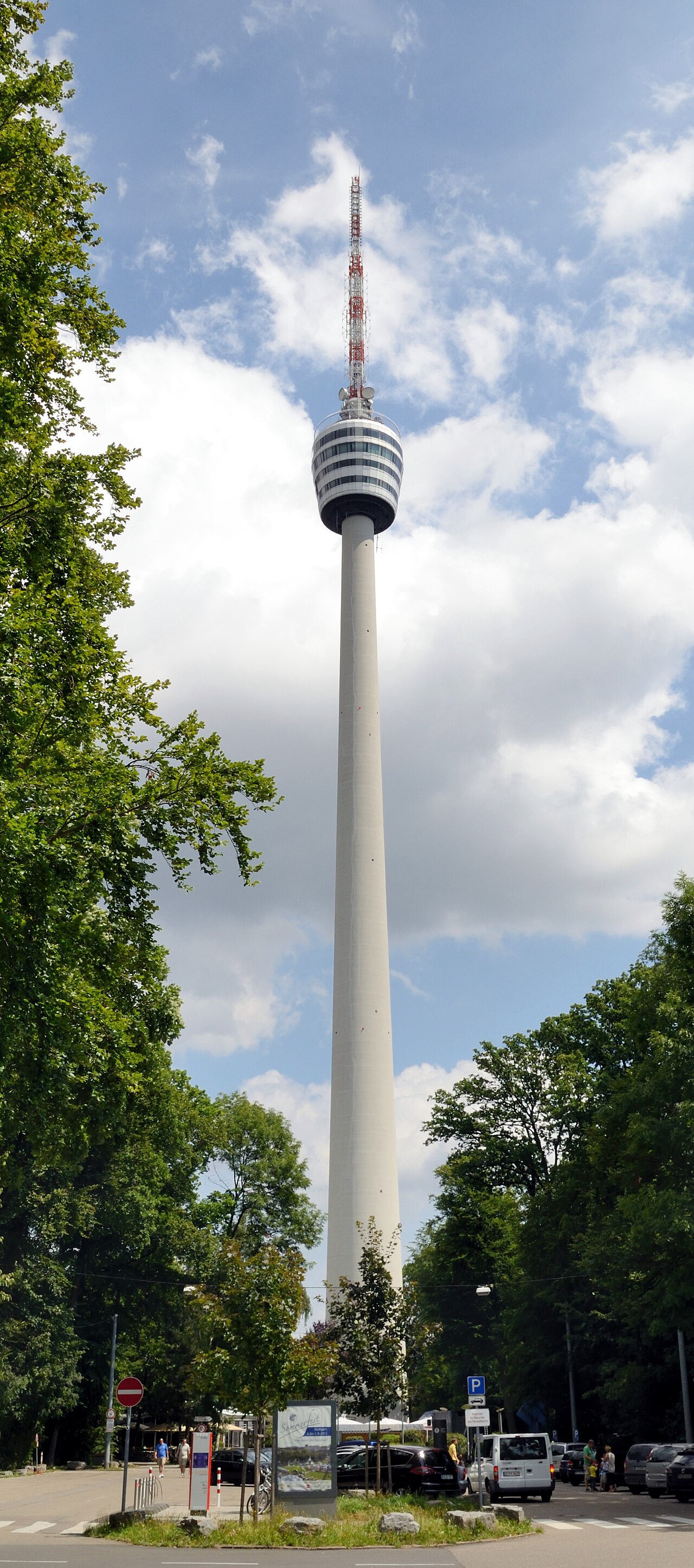
Before 1956, broadcast antennas were steel lattice masts held up by guy wires. The engineer Fritz Leonhardt proposed something else for Stuttgart: a slender shaft of reinforced concrete, free-standing, with a public observation deck and a restaurant near the top to help pay for it. It went up to 217 meters, about 712 feet, and it worked.
Every concrete broadcast tower built since is a descendant of this one. The CN Tower in Toronto, the Tokyo Tower's successors, the towers in Moscow and Berlin: all of them borrow the Stuttgart principle of a concrete shaft carrying both transmission equipment and paying visitors. That is an unusual thing for a mid-sized German city to be able to claim, and it is the reason architecture and engineering people make the pilgrimage up here.
The observation deck sits at 150 meters, roughly 492 feet. From it the view covers the Neckar valley, the surrounding vineyards, the ridge of the Schwäbische Alb (Swabian Jura) to the southeast and, on clear days, as far as the edge of the Schwarzwald (Black Forest).
Eating at the top
There is a panorama cafe up in the tower head, and the restaurant Leonhardts sits at 147 meters, about 482 feet, serving modern Swabian cooking. Tables at that altitude go quickly, so reserve rather than turn up hopeful.
Swabian food is the regional cuisine of this part of Germany and it is worth trying at least once while you are here: Maultaschen, which are large filled pasta pockets somewhere between ravioli and a dumpling, and Spätzle, a soft egg noodle that gets served with almost everything.
Getting up there and when to go
The tower stands at Jahnstraße 120 in Degerloch, the district on the high ground south of the city center. Stuttgart sits in the Kessel, the bowl-shaped valley the downtown occupies, and Degerloch is up on the rim, which is precisely why the tower was built here. Stadtbahn light rail and city buses serve it, and there is road access if you are driving.
The scenic way up the hillside is the Zacke, Stuttgart's rack railway. It has climbed from Marienplatz in the southern part of downtown to Degerloch since 1884, covering a little over a mile at gradients of up to 17.8 percent. It is not a tourist attraction bolted onto the transit system; it is part of the transit system, so an ordinary VVS ticket covers it. The Zacke does not stop at the tower itself, but taking it up and connecting onward turns the trip into something worth doing in its own right.
Sunset is the payoff hour. An hour to two hours covers the deck, the cafe and the walk around the base; leave more time if you plan to eat.